
What Design & Construct Actually Means in Sydney, And Why It Protects Your Budget
Most of the budget overruns we're asked to review on Sydney projects don't originate on site. They originate months earlier, in the gap between a completed architectural design and the first builder who looks at it with a pricing pen in hand. By the time a homeowner in Mosman or a developer in Alexandria has three tender returns sitting in their inbox with a $400,000 spread between them, the damage is already done: the design was never pressure-tested against real-world build cost, programme, or procurement. This is the problem design and construct Sydney projects are structured to solve, and it's the reason sophisticated clients increasingly ask for a D&C pathway before an architect touches a pencil.
The Design-Bid-Build Model, And Why It Quietly Fails High-End Sydney Projects
The traditional procurement route in NSW residential construction runs sequentially. An architect is engaged, a design is developed through schematic, design development, and contract documentation, and only then is the project tendered to builders. On paper, this gives the client design freedom and competitive pricing. In practice, on projects above roughly $1.5M, it produces three predictable failures.
The first is pricing variance. When three builders tender a fully documented architectural set, the returned prices often vary by 15 to 25%. That variance isn't usually about margin. It's about how each builder has interpreted specification gaps, buildability assumptions, and allowances for items the drawings didn't resolve. The client is then forced to choose between the lowest number (which almost certainly contains the most provisional sums) and a higher number (which may simply have read the documents more carefully).
The second is the redesign loop. Once a builder is appointed, value management begins. Items that were designed without buildability input (cantilever slabs with inadequate structural depth, façade systems the joiner can't procure within programme, waterproofing details that won't pass a Class 2 certifier) come back to the architect for revision. Every redesign loop costs four to eight weeks and triggers additional consultant fees.
The third, and most corrosive, is accountability fragmentation. When something goes wrong on site, the builder points to the drawings, the architect points to the builder's interpretation, the structural engineer points to both, and the client sits in the middle paying for the argument. This is the single most common reason high-end Sydney renovations blow their contingency in the first trimester of construction.
What Design & Construct Actually Means (And What It Doesn't)
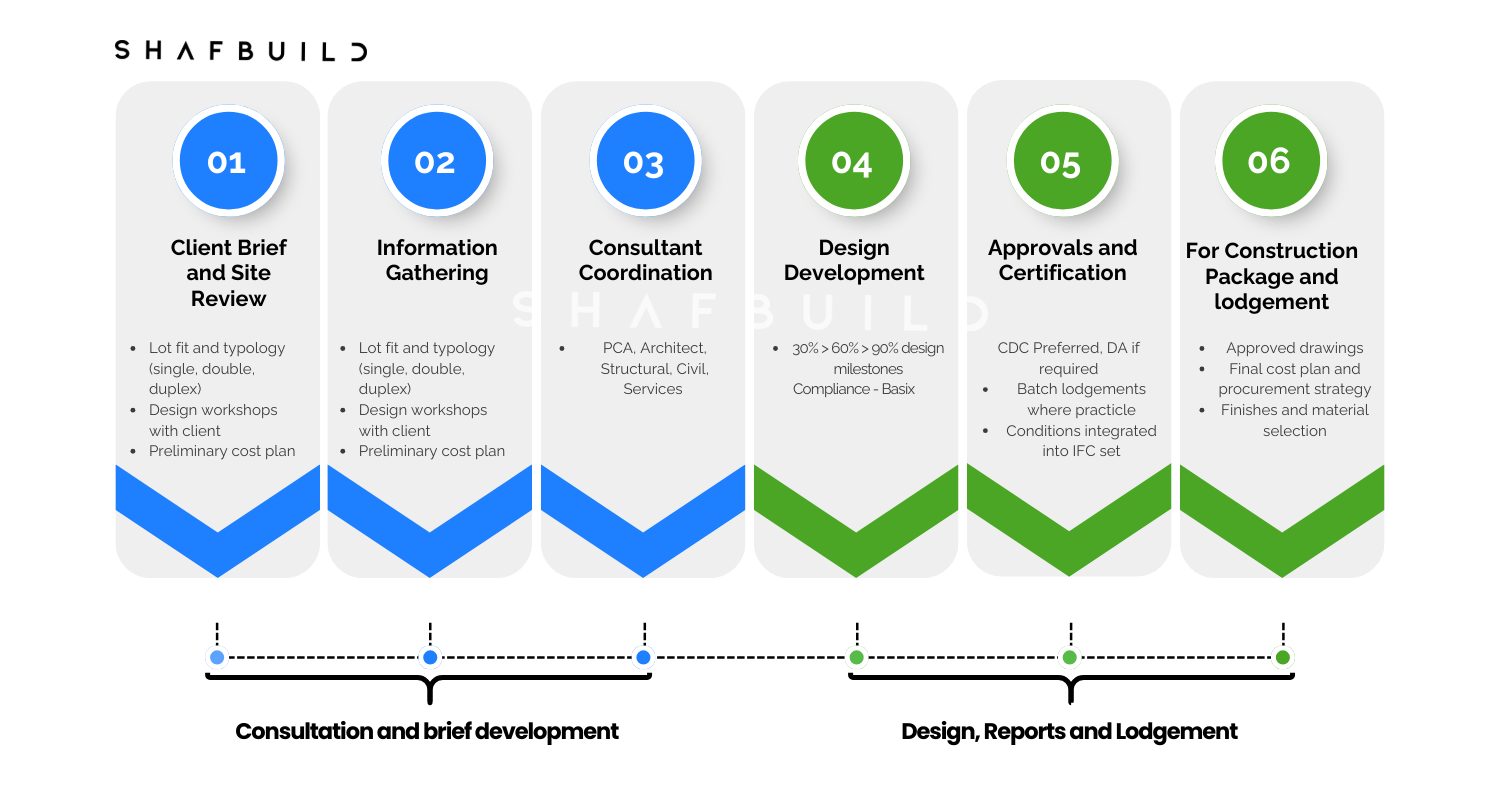
Design and construct, properly structured, is a single-contract delivery model where the builder takes responsibility for both the design and the construction of the project under one contract, one programme, and one point of accountability. The builder engages the architect, structural engineer, hydraulic consultant, and other designers directly, either in-house or under consultant agreements, and warrants the design outcome as part of the delivery.
That's the technical definition. What it means in practice on a Sydney project is more specific, and worth understanding clearly.
It does not mean the client loses design control. A well-run D&C process gives the client the same design development access they'd have under a traditional architect-led engagement, including selection of the design lead. What changes is that the design is being developed inside a live constructability and cost envelope, not in abstraction.
It does not mean "design and build" in the volume-builder sense. Project home builders who market a design and construct service are typically offering a fixed floor plan selection with limited variation. That's a procurement model, not a D&C process. True D&C on bespoke residential or medium-rise Class 2 work involves original design under a practitioner-grade delivery framework, usually contracted under AS 4902-2000 or a negotiated derivative.
What it does mean, contractually, is that the builder carries the design risk. If the architectural documentation produces a detail that fails on site, that's a builder problem to solve, not a client problem to re-engage consultants over. This is the single most valuable protection D&C offers, and the one clients most often underestimate when comparing procurement options.
The NSW Regulatory Context: Why D&C Has Become More Rigorous Since 2020
Anyone engaging a builder in NSW for Class 2 work (residential apartment buildings) or for certain Class 3 and 9c buildings must now contend with the Design and Building Practitioners Act 2020. The Act, administered by NSW Fair Trading, introduced a registered practitioner regime that fundamentally changed how design responsibility is documented and warranted.
Under section 9 of the Act, regulated designs must be prepared by a registered design practitioner who provides a signed design compliance declaration. Under section 37, the builder carries a statutory duty of care to subsequent owners for economic loss from defects. In a D&C context, this compresses the design warranty and the build warranty into a single accountable entity, which is exactly where the structure performs best.
For Class 1 work (detached dwellings, knock-down-rebuilds, most renovations), the DBP Act doesn't apply in the same form, but the Home Building Act 1989 statutory warranties do, and they run for six years on major defects from completion. A D&C builder is warranting both the design they've procured and the work they've constructed against those statutory warranties. A traditionally procured builder is only warranting their construction work against documentation prepared by others.
This distinction matters most when something goes wrong four years after practical completion. Under D&C, there's one party to notify. Under design-bid-build, there are often three, and the fastest way to watch a Home Building Compensation Fund claim stall is to introduce a dispute about whether the defect is a design issue or a workmanship issue.
Where Early Builder Involvement Changes The Outcome
The technical argument for D&C is accountability. The practical argument is timing. Early builder involvement, which is what D&C enables structurally, changes outcomes most visibly at three points in a project.
At concept stage
Structural concept decisions made without a builder in the room are the most expensive form of design oversight we see in Sydney. Cantilevers, transfer structures, and long-span elements get drawn on the basis of what's architecturally desirable, not what's economically and programmatically buildable on the specific site. A builder at concept stage tests the design against real crane access, real slab depths, real post-tensioning lead times, and real neighbour-access realities before the design is locked in.
Consider a common scenario in the upper north shore. A sloping site in an LGA like Ku-ring-gai or Hornsby comes forward for a new build in the $2.4 to 2.8M investment band, with an architect-designed concept proposing a suspended ground-floor slab spanning a 9-metre living pavilion. Structurally, it's achievable. The question D&C forces at concept stage, and design-bid-build defers to tender, is whether it's buildable on this specific site within a sensible programme.
The issue with a 9-metre clear span of that nature is typically the structural solution: a post-tensioned slab, which carries a 6 to 10 week procurement and stressing window, and often requires crane positioning that sloping sites with tight neighbour boundaries can't accommodate without a formal access licence from the adjoining owner under the Access to Neighbouring Land Act 2000 (NSW). On a Ku-ring-gai slope with mature tree controls under the Council's Tree and Vegetation DCP, the crane stand-up zone alone can become the critical-path problem, before a single cubic metre of concrete has been poured.
Where early builder involvement changes the outcome is at the concept sketch, not the tender return. Alternative structural strategies (rotating the spanning direction, introducing a concealed steel transfer beam, or breaking the pavilion with a non-structural pier) are all options a builder and structural engineer can workshop with the architect before the design is locked. Under a traditional design-bid-build pathway, this gets discovered when the builders price the tender set, the post-tensioning subcontractor flags the access issue, and the drawings return to the architect for redesign. That's a routine 8 to 12 week delay before a contract is even signed, and it's the single most common reason premium Sydney new builds miss their target start date.
At DA or CDC lodgement
The approval pathway chosen at the start of a project has a compounding effect on every decision that follows. Complying Development under the State Environmental Planning Policy (Exempt and Complying Development Codes) 2008 has specific envelope, setback, and site coverage controls that are non-negotiable. A Development Application under the relevant Local Environmental Plan allows variation but carries a 10 to 16 week assessment risk, longer in councils like Woollahra or Ku-ring-gai where heritage and tree controls add complexity. A D&C builder involved at feasibility can often identify, within a single site walk-through, whether the proposed scope will fit CDC or requires DA, which sets the entire project timeline realistically from day one.
At procurement lock-in
Long-lead items on Sydney premium projects (European windows, specified stone, bespoke joinery, imported tapware) regularly run 16 to 28 weeks. On a D&C programme, these are identified during design development and ordered against the construction programme so delivery aligns with the install sequence. On design-bid-build, they're specified in the architectural set, priced at tender, ordered after contract signature, and routinely become the reason a project misses its practical completion date by two to three months.
Where Clients Typically Get D&C Wrong
The most common misconception is that D&C means "cheaper." It doesn't, and any builder framing it that way is selling something else. A properly run D&C process produces cost certainty, not cost reduction. The cost certainty is the value proposition.
The second misconception is that D&C removes the need for an independent design review. It doesn't, and on projects above $5M a recommendation to clients is to engage a superintendent or an independent certifier under AS 4902 to review key design gateways. This is the builder's recommendation, not a client imposition, and it's the sign of a builder confident in their process.
The third misconception, and the one that causes the most friction during delivery, is how variations are priced under a D&C contract. Under AS 4902-2000, the contract establishes agreed rates and margins for general variation work (preliminaries, programme-related costs, the builder's overhead and margin percentage applied to variation value), but that framework does not mean every variation is simply pulled off a schedule.
Specification changes that depend on subcontractor or supplier pricing (joinery packages, stone selections, specified windows, bespoke metalwork, tiling upgrades) have to be priced against fresh quotations from the relevant trade or supplier at the time of the variation. A kitchen joinery upgrade from a $90,000 package to a $180,000 package can't be resolved by a line in a rate schedule; it requires the joiner to re-price against the new drawings, lead times to be reconfirmed, and the programme impact to be assessed. The builder's margin and preliminaries overlay are contractually defined, but the underlying trade cost is a live market number, not a pre-agreed rate.
Where clients get this wrong is assuming one of two extremes: either that variations are a fresh competitive tender (they're not, because you're inside a contract with an appointed builder), or that every variation can be priced instantly from a rate sheet (it can't, because the underlying supply and trade costs move). The correct expectation is the middle ground: transparent variation pricing, a documented breakdown showing trade quotation plus agreed overhead and margin, and a contractual framework that makes the build-up auditable. That's a conversation worth having at contract execution, not at week 20 when the first significant variation lands on the superintendent's desk.
The Decision Framework: When D&C Is The Right Procurement Route
D&C is not the correct answer for every project. For reference, the following typologies are where it consistently produces the strongest outcomes for Sydney clients:
- New builds on complex sites (sloping, flood-affected, bushfire-prone, heritage-adjacent) where constructability input at concept stage is most valuable.
- Knock-down-rebuilds in established suburbs where programme certainty matters to clients carrying rental costs during construction.
- Class 2 medium-rise residential where the DBP Act compliance load is most efficiently carried by a single practitioner-grade entity.
- Duplex and townhouse developments where feasibility depends on getting design, cost, and approval pathway aligned before land commitment.
- Renovations where the scope crosses into structural modification, complex nature & large scope of works, or significant services upgrades.
- Heritage Where D&C delivers particular value: heritage-listed properties. Within the D&C process, Shafbuild engages heritage consultants to work alongside architects from concept stage, ensuring the project is shaped around the conservation conditions attaching to the listing (whether that's a State Heritage Register listing under the Heritage Act 1977, a Local Environmental Plan heritage schedule, or a Heritage Conservation Area control). This matters because each Sydney council interprets heritage provisions differently in practice, and what Woollahra, Inner West, or Ku-ring-gai will approve on a contributory item is not a question that can be answered from the drawings alone.
- Our Design stage takes this further. Rather than designing in isolation and hoping for approval, we build pre-lodgement conversations with council heritage officers into the process, identifying and confirming the acceptable envelope of works before documentation is finalised. That structured, approval-aware design pathway is precisely where D&C outperforms a traditionally procured heritage project: the design is pressure-tested against what will actually be consented, not what looks defensible on paper.
How The D&C Contract Actually Works
Sydney premium residential and Class 2 D&C projects are most commonly contracted under AS 4902-2000, the Australian Standard general conditions of contract for design and construct. It's worth understanding the structural logic of this contract, because it differs materially from the HIA or MBA lump-sum contracts used on design-bid-build residential work.
Under AS 4902, the builder (contractor) takes on design responsibility under a Principal's Project Requirements document, which is the client's functional brief. The contractor warrants that the completed works will be fit for the stated purpose and will comply with the statutory and regulatory framework. The superintendent, typically engaged by the client, administers the contract but does not direct the builder's means and methods.
Variations are handled through a formal variation order process with defined pricing mechanisms. Progress claims follow an agreed schedule of values. Defects liability runs for a specified period (commonly 12 months) post-practical completion, on top of the six-year statutory warranty under the Home Building Act.
The reason AS 4902 matters is that it's a balanced contract. It's not drafted to favour the builder (the way some bespoke building contracts are) and it's not drafted to favour the client (the way some agency-drafted agreements are). It's the contract architects, quantity surveyors, and superintendents across NSW are used to administering, which makes dispute resolution cleaner if it's ever required.
The Cost Protection Argument, Made Properly
What D&C produces is cost certainty, which on a premium Sydney project is almost always the most valuable outcome. The specific protections are:
- Scope clarity at contract signature. Because the builder has developed the design inside a live cost envelope, the contract sum reflects a buildable, procurable scope. Provisional sums are minimised and prime cost items are agreed transparently.
- Reduced variation volume. A well-run D&C project typically runs 4 to 8% variation volume through construction. A traditionally procured project on comparable scope commonly runs 12 to 20%, driven largely by documentation gaps and value management post-tender.
- Programme certainty. Because long-lead items are procured against a real programme, and because design changes during construction are captured through a structured variation process, practical completion dates hold more reliably.
- Single-point defect accountability. Under the Home Building Act 1989 statutory warranty regime, and under the DBP Act where applicable, the client has one party responsible for the complete outcome.
The Honest Part: What's Harder Under D&C
A premium D&C engagement requires more of the client at the front end than a traditional procurement route does. Design development happens with the builder in the room, which means the client needs to engage with buildability, procurement, and cost questions during concept stage rather than at tender. Clients who prefer to develop a design to completion before speaking to a builder will find the D&C model uncomfortable.
The other genuinely hard part is builder selection. Because the builder is carrying both the design and construction responsibility, the decision is harder to reverse than selecting a builder from a competitive tender. Due diligence on licensing (the NSW Fair Trading public register), practitioner registration (for Class 2 work, the DBP Act register), insurance currency, and delivered project verification matters more at the outset, because you're choosing a partner for the entire project lifecycle, not a contractor for a defined scope.
These are real trade-offs, and the right answer for a specific client depends on the project typology, the client's time availability during design, and the weight they place on cost certainty versus design optionality. The role of the builder in that conversation is to help the client make that assessment honestly, not to advocate for the procurement route that happens to suit the builder's book.
The Practical Takeaway
For clients who want confidence their project will be built correctly, on budget, on programme, and to the brief they signed off, Design & Construct is the answer.
The reason it works is simple. When your builder is involved through design, every decision is made with real cost and construction knowledge behind it. By the time you sign a contract, the scope is resolved, the numbers are real, and the surprises that derail traditionally procured projects have already been designed out. You're not handing a finished set of drawings to a builder who had no input in creating them. You're appointing a team who helped shape the project and are now carrying it across the line.
That continuity, from first sketch to practical completion, is what produces genuine certainty. One builder. One point of accountability. A programme that holds because it was built on a design that was already resolved.
At Shafbuild, this is how every project is run. Clients are brought in early, kept informed at every stage, and handed a contract that reflects the project they actually want to build. The same team that worked through design is the team on site. That relationship, and the trust it builds, is what makes the difference between a project that delivers and one that disappoints.
The best time to have this conversation is before an architect is briefed, not after. If you're planning a project and want to understand what early builder involvement could mean for your outcome, we'd welcome the conversation.
Ready to plan a Sydney design and construct project?
Shafbuild delivers bespoke residential and Class 2 D&C projects across Sydney under a single contract, early involvement model. If you're considering a new build, knock down rebuild, duplex, or medium rise development, we'll walk through the feasibility, approval pathway, and delivery structure with you before any contract is on the table.
Shafbuild holds a NSW Builder's Licence and a Building Practitioner Licence Class 2 (Medium Rise). Founded by a construction leader with 14 years of high value complex residential & commercial experience across Sydney.
Where Design Meets Delivery.
Our team brings design, approvals, and construction under one roof with a single point of accountability. We work with homeowners, investors, and commercial clients who expect their project delivered properly and a result they're genuinely proud of. Every project is personally led by Dan, from day one through to handover.